Note
Go to the end to download the full example code.
Temporary Earth Capture
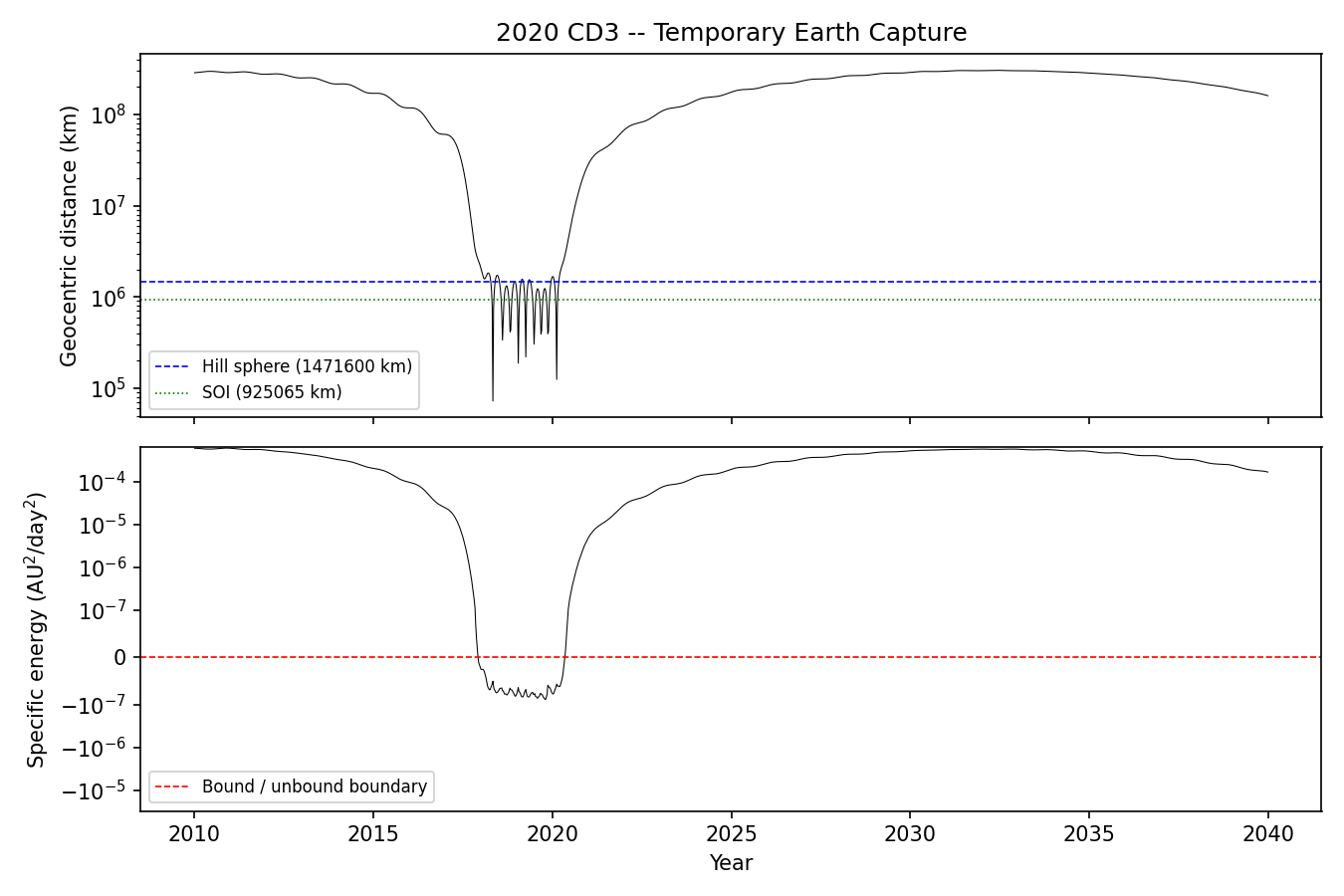
Some near-Earth asteroids pass close enough to Earth that they become temporarily captured, orbiting the planet for months or years before escaping back onto heliocentric orbits. These so-called “mini-moons” spend time inside Earth’s Hill sphere and have geocentric specific energy below zero while captured.
This example uses 2020 CD3 – the second known natural object to be temporarily captured by Earth – to demonstrate kete’s orbital analysis tools: geocentric specific energy and Earth’s Hill sphere / sphere of influence.
2020 CD3 is roughly a meter across, so solar radiation pressure is a significant perturbation and the JPL orbit solution includes a non-gravitational term. That term is passed to the propagation below.
The orbit solution has an epoch several years after the capture, so the trajectory shown here is integrated backwards through a sequence of close perigee passages. Small differences in the force model grow quickly across those passages, so the window starts in 2018 and does not extend back to the capture itself in 2017. The daily sampling used here also does not resolve perigee: the plotted minima are upper bounds on the true perigee distances.
import matplotlib.pyplot as plt
import numpy as np

import kete
Fetch 2020 CD3 and set up the time window
We fetch the orbit from JPL Horizons and define a window covering the final years of the capture and the escape in 2020.
obj = kete.HorizonsProperties.fetch("2020 CD3")

jd_start = kete.Time.from_ymd(2018, 1, 1).jd
jd_end = kete.Time.from_ymd(2040, 1, 1).jd

# Solar radiation pressure, from the JPL orbit solution.
non_gravs = obj.non_grav

# Propagate to the start of the window
state = kete.propagate_n_body(obj.state, jd_start, non_gravs=non_gravs)
Physical constants
Earth’s Hill sphere and sphere of influence.
planet = "Earth"

earth_hill = kete.hill_radius(planet)
earth_soi = kete.sphere_of_influence(planet)

print(f"Earth Hill radius:     {earth_hill * kete.constants.AU_KM:.0f} km")
print(f"Earth sphere of influence: {earth_soi * kete.constants.AU_KM:.0f} km")
Earth Hill radius:     1471600 km
Earth sphere of influence: 925065 km
Propagate through the capture event
Step through the time window recording geocentric distance and specific energy at each epoch. The geocentric orbits have a period of about 75 days.
step = 7.0  # days
times = np.arange(jd_start, jd_end, step)

geo_dist_km = []
spec_energy = []

for jd in times:
    state = kete.propagate_n_body(state, jd, non_gravs=non_gravs)

    # Geocentric state for distance and specific energy
    geo_state = state.change_center(planet)
    r_km = geo_state.pos.r * kete.constants.AU_KM
    geo_dist_km.append(r_km)

    energy = kete.specific_energy(geo_state)
    spec_energy.append(energy)


geo_dist_km = np.array(geo_dist_km)
spec_energy = np.array(spec_energy)

# Convert JD to fractional year for the x-axis
t_years = [kete.Time(jd).year_float for jd in times]
Plot the results
Two panels show the capture event:
Geocentric distance relative to Earth’s Hill sphere and sphere of influence.
Geocentric specific energy – negative values indicate a bound orbit around Earth. The axis is clipped to the bound episode; outside the capture the energy is several hundred times larger.
fig, axes = plt.subplots(2, 1, figsize=(9, 6), sharex=True, dpi=150)

ax = axes[0]
ax.plot(t_years, geo_dist_km, "k-", lw=0.5)
ax.axhline(
    earth_hill * kete.constants.AU_KM,
    color="blue",
    ls="--",
    lw=0.8,
    label=f"Hill sphere ({earth_hill * kete.constants.AU_KM:.0f} km)",
)
ax.axhline(
    earth_soi * kete.constants.AU_KM,
    color="green",
    ls=":",
    lw=0.8,
    label=f"SOI ({earth_soi * kete.constants.AU_KM:.0f} km)",
)
ax.set_ylabel("Geocentric distance (km)")
ax.set_yscale("log")
ax.legend(fontsize=8)
ax.set_title(f"{obj.desig} -- Temporary Earth Capture")

ax = axes[1]
ax.plot(t_years, spec_energy, "k-", lw=0.5)
ax.axhline(0, color="red", ls="--", lw=0.8, label="Bound / unbound boundary")
ax.set_ylabel("Specific energy (AU$^2$/day$^2$)")
ax.set_xlabel("Year")
bound = spec_energy[spec_energy < 0]
ax.set_ylim(2 * bound.min(), -2 * bound.min())
ax.legend(fontsize=8)

plt.tight_layout()
plt.show()
Total running time of the script: (0 minutes 9.978 seconds)